

Your room can look styled and still feel strangely unfinished. The right ceiling decor ideas make a room feel finished by tying the overhead surface to the room’s color, light, and mood.
That plain white ceiling may be cutting the space in half. It can make warm walls look harsh, cozy furniture feel flat, and finished corners feel incomplete.
How can I make a room look better by decorating the ceiling? Start by looking up before buying more decor, then decide whether the ceiling should blend, soften, contrast, or become a quiet focal point.
Why the Ceiling Is the Missing Surface in Your Room

Why does the ceiling matter in room design?
The ceiling matters because it changes how tall, cozy, bright, and finished a room feels. When you ignore it, the room can feel cut off at the top. When you treat it as the fifth wall, the ceiling can support the color story, soften contrast, and make the whole space feel planned.
You can style the sofa, layer the rug, hang the art, and still feel like something is missing.
Most of the time, that missing piece sits right above your head.
A plain ceiling is not always wrong. Many rooms need a simple ceiling. The problem starts when the ceiling has no link to the rest of the space.
A bright white ceiling above warm beige walls can look cold. A builder white ceiling above moody green walls can create a sharp ceiling line. That line can make the room feel shorter or less polished.
Sherwin Williams calls the ceiling the true fifth wall. That idea matters because a ceiling is not empty space. It is a large surface that affects the room every time you walk in.
RMCAD also notes that ceiling design can shape the mood, tone, and style of a space. You do not need an ornate ceiling to use that idea. You only need to stop treating the ceiling like an afterthought.
Color, finish, texture, and light reflection all play a role. A flat paint finish feels soft. A glossy finish can bounce light, but it can show every bump. A soft tinted white can calm a room more than a harsh white.
This is where fifth wall decor becomes useful. It does not have to mean bold stripes or heavy pattern. It can mean one quiet choice that makes the ceiling feel connected.
The ceiling does not need drama. It needs intent.
Once you see the ceiling as part of the room, the cheapest fix becomes obvious.
The $0 Ceiling Fix Uses What the Room Already Has

What is the easiest no cost ceiling decor trick?
The easiest no cost ceiling decor trick is to treat the ceiling as part of the room’s color story before buying anything new. If you have leftover wall paint, repeat it on the ceiling or use a softened version. This reduces visual breaks and makes the room feel more finished.
This works because the room already gives you clues.
Look at your rug. Check your curtains. Notice the art, bedding, throw pillows, lamp shades, or upholstery. Those colors can guide the ceiling better than a random paint chip.
If you have leftover paint, start there. A little paint may be enough for a small ceiling, a border, or a color cap around the top edge of the room.
Benjamin Moore lists its Waterborne Ceiling Paint coverage at 400 to 450 square feet per gallon. That helps you see why leftover paint can go further than expected in a compact room.
This does not mean every ceiling should match the walls. It means the ceiling should relate to something.
Lick describes colour drenching as taking one color across walls, woodwork, doors, picture rails, and ceilings. That idea supports a simple truth. A ceiling feels calmer when it belongs to the same palette as the room.
You can also make a free choice before spending money. Pause before buying another pillow, print, or lamp. Ask what the ceiling is doing first.
Use this quick check:
- Does the ceiling feel too bright?
- Does it clash with the wall color?
- Does it make the room feel shorter?
- Does it feel forgotten?
- Does it need to blend or stand out?
Real Simple notes that painting the ceiling the same color as the walls can make a space look bigger, cleaner, and more dramatic when done well.
That is the power of soft contrast. You are not adding clutter. You are removing a visual break.
The next step is choosing what that overhead color should do.
How Ceiling Color Changes the Feeling of the Room
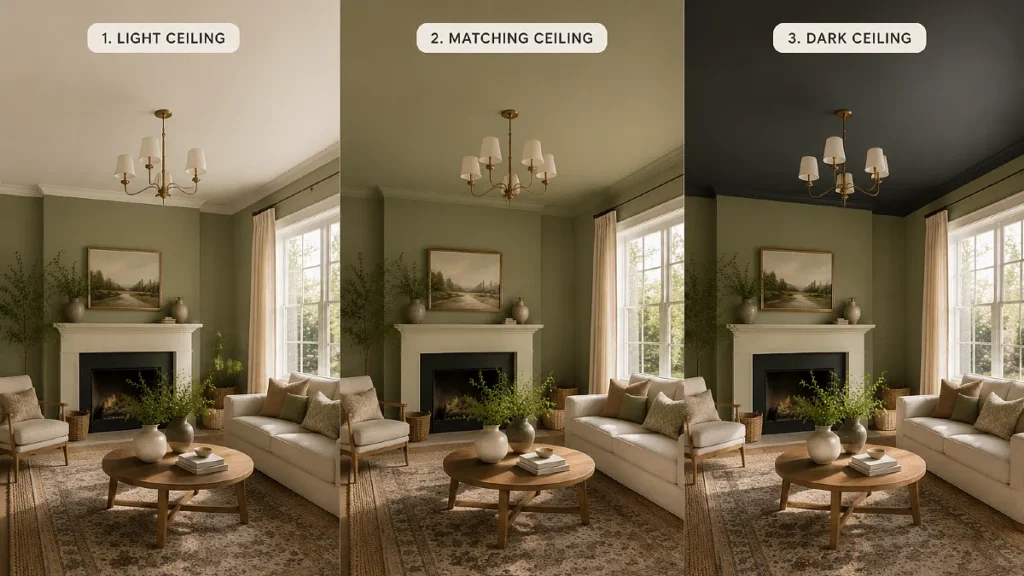
Ceiling color changes the way your eye reads the room.
A ceiling is not just a lid. It can push the space open, pull it closer, or make the walls feel smoother.
Better Homes and Gardens explains that lighter ceilings tend to feel taller and airier. Darker ceilings can visually lower height and add intimacy.
That is why one color can feel perfect in one room and wrong in another.
A soft white ceiling works well when the room needs air. Choose a white with the same undertone as the walls. Warm walls need a warmer white. Cool walls need a cleaner white.
A matching ceiling works when you want flow. It blurs the edge where the walls meet the ceiling. This helps small rooms, sloped rooms, and awkward corners feel calmer.
A dark ceiling works best when the room can handle mood. Think tall ceilings, soft lamps, deep wall colors, heavy curtains, or a cozy reading room.
Houzz found that searches for dark ceiling were up 60 percent year over year in its 2024 U.S. Emerging Summer Trends Report. That shows people want ceilings with more depth and warmth.
Still, dark paint needs care. A dark ceiling with weak lighting can feel heavy. A dark ceiling with layered lamps can feel rich and settled.
This table shows which ceiling choice works best for different room needs.
| Ceiling choice | Best for | Effect on the room | Cost level | Best keyword fit |
|---|---|---|---|---|
| Same color as walls | Small rooms, sloped ceilings, cozy spaces | Makes the room feel continuous | $0 with leftover paint | same color ceiling and walls |
| Soft tinted white | Warm neutral rooms | Softens harsh contrast | Low | ceiling paint ideas |
| Darker ceiling | Tall rooms, moody bedrooms, intimate rooms | Adds depth and coziness | Low to medium | dark ceiling |
| Wallpapered ceiling | Small rooms, powder rooms, reading nooks | Adds pattern overhead | Medium | ceiling wallpaper |
| Ceiling medallion | Rooms with plain light fixtures | Adds architectural detail | Low to medium | ceiling decor ideas |
The safest rule is simple.
Use lighter colors for air, darker colors for cozy depth, and matching colors for flow.
That is why matching the walls can work better than most people expect.
When You Should Paint the Ceiling the Same Color as the Walls
Should I paint my ceiling the same color as my walls?
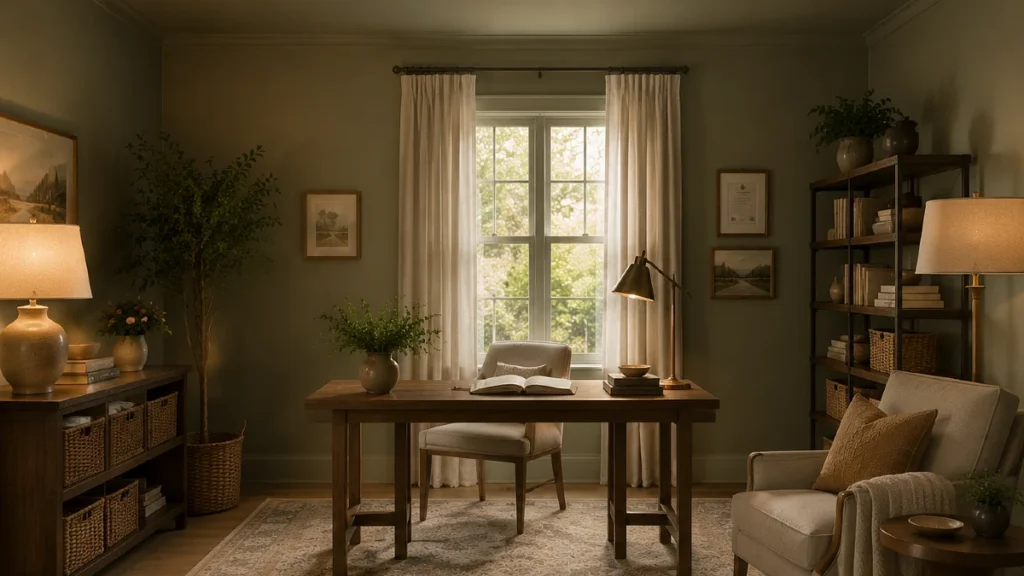
Paint your ceiling the same color as your walls when you want the room to feel smoother, cozier, or more intentional. This works especially well in small rooms, sloped rooms, and spaces with awkward ceiling lines. Use a flat finish overhead to keep flaws from catching light.
The same color ceiling and walls idea sounds bold at first. In real rooms, it often feels quieter than a sharp white ceiling.
It works because your eye does not stop at the ceiling line. The room feels wrapped instead of chopped into parts.
This is especially helpful in rooms with tricky shapes. A sloped bedroom ceiling can look calmer when the wall color continues upward. A boxy home office can feel more designed when the top edge disappears.
The same trick helps small spaces. When the ceiling and walls share color, the room can feel more continuous. You notice the whole room, not the break between surfaces.
When the same color ceiling and walls work best
Use this look when your room has:
- Low contrast decor
- Sloped or angled ceilings
- Soft natural light
- Warm lamps at night
- A cozy or cocooned mood
- A wall color you already love
If the wall color feels strong, you can soften it overhead. Many decorators use a lighter version on the ceiling. Even 25 to 50 percent lighter can keep the mood without making the room feel closed in.
A flat paint finish is usually best. It hides small flaws better than shine. It also keeps the ceiling from catching too much light.
Sue Wadden, Director of Color Marketing at Sherwin Williams, has described color as fresh and livable when brightness has warmth. That idea applies well to ceilings. Strong color overhead feels easier when the undertone feels warm and grounded.
You should skip this trick when the room already feels too dark. If there is one small window and one weak ceiling light, start with a softer white instead.
Paint is the simplest route, but it is not the only ceiling fix.
Low Cost Ceiling Decor Ideas That Go Beyond Paint

Ceiling decor can be subtle. It does not need to shout.
Paint is the easiest start, but some rooms need pattern, texture, or a small architectural detail. The key is scale. The ceiling should support the room instead of fighting every other surface.
Houzz UK 2026 trend data found wallpapered ceiling searches up 88 percent. It also found exposed wooden beams up 79 percent, wooden ceiling up 36 percent, and painted ceiling up 31 percent.
That shows a clear shift. More people are treating ceilings as part of the design plan.
Peel and stick wallpaper is one low commitment option. Tempaper lists removable wallpaper from $38.39, and some Tempaper rolls at Home Depot show prices around $29.99 to $47.99.
Use ceiling wallpaper in a small space first. A reading nook, small bedroom, entry corner, or powder room can handle pattern better than a large open room.
A painted stripe can also work. Pinterest Predicts 2026 lists striped ceiling up 40 percent. This does not mean you need carnival style stripes. A soft tone on tone stripe can add movement without taking over.
FrogTape helps when you want crisp lines for a painted border, color cap, or simple stripe. Keep the design simple if you have textured ceilings.
A ceiling medallion is another smart fix. It can make a basic light fixture feel more finished. It works best when the room already has classic trim, vintage furniture, or a soft layered style.
Wood toned panels and faux beams add warmth. They work best when the room already has wood floors, woven shades, brown furniture, or natural textiles.
Interior designer Lauren Saab, founder and principal designer of Saab Studios, has said that ceilings can become a sensory surface instead of an afterthought. That quote is about texture, but the idea works for paint, wallpaper, wood, and pattern too.
Before you choose any detail, look at the room’s visual height. A low ceiling needs restraint. A tall ceiling can handle more weight.
The trick is knowing when a ceiling detail helps and when it becomes too much.
Ceiling Mistakes That Make a Room Feel Less Finished

The wrong ceiling choice can make a room feel shorter, busier, or less polished.
Most ceiling paint mistakes happen because the ceiling gets decided last. By then, the room already has color, texture, lights, and furniture. A rushed ceiling choice can throw everything off.
The most common mistake is leaving the ceiling bright white by default. Bright white can work in crisp rooms. But in warm rooms, it can look cold and separate.
Another mistake is choosing a dark ceiling without enough light. Dark color needs support. Add lamps, sconces, or warm bulbs before you go deep overhead.
Gloss can also cause trouble. A glossy ceiling reflects light, but it can show bumps, seams, and texture. Behr’s Premium Plus Ceiling Paint is a flat ceiling paint that the brand says helps minimize surface imperfections.
Behr also lists ceiling paint coverage at 250 to 400 square feet per gallon. Home Depot lists Behr Premium Plus Ceiling Paint at $33.98 for a 1 gallon option at the time of checking.
Benjamin Moore Waterborne Ceiling Paint is another real product to compare. One retailer lists it around $49.95 per gallon, and Benjamin Moore lists coverage at 400 to 450 square feet per gallon.
This table shows common ceiling problems and the quickest fix for each one.
| Ceiling problem | Why it hurts the room | Quick fix | Best for renters? |
|---|---|---|---|
| Stark white ceiling with warm walls | Creates a hard visual stop | Use a warmer white or repeat wall color | Yes, if paint is allowed |
| Low ceiling feels heavy | Dark color may compress space | Use soft light color with low contrast | Yes |
| Tall ceiling feels cold | Too much empty vertical space | Try a deeper tone or soft pattern | Sometimes |
| Ceiling flaws show | Wrong sheen reflects bumps | Use flat ceiling paint | Yes, if paint is allowed |
| Room feels almost finished | Ceiling has no relationship to decor | Pull color from rug, art, or curtains | Yes |
Ceiling fixtures matter too. Do not forget vents, beams, trim, medallions, and light covers. They all sit inside the same overhead focal point.
A patterned ceiling can also go wrong when the room already has loud curtains, busy bedding, or a strong rug. Pick one star surface.
Soften contrast, choose the right sheen, and repeat the room’s palette. That fixes most ceiling color mistakes.
Before you change anything, run one simple test.
The Simple Ceiling Test Before You Buy More Decor

Stand in the doorway and take one full room photo.
That photo will show what your eye ignores in real life. You will see whether the ceiling blends, clashes, or disappears.
This ceiling color test works because a photo flattens the room. It shows contrast faster than your eye does. If the ceiling looks too bright in the photo, it probably feels too bright in the room.
Start with the doorway test. Stand where you first enter the room. Look at the whole space, including the ceiling. Ask whether the top of the room feels connected to the bottom.
Next, check the ceiling line in daylight. Natural light can make a white ceiling look cooler. It can also make a dark ceiling feel heavier than expected.
Then check the same line at night. Lamps change everything. A ceiling that feels plain in the morning can feel cozy under warm bulbs.
Use the Sherwin Williams Color Expert app or another paint visualizer if you want to test color before painting. Digital tools are not perfect, but they can help you compare mood.
Then try one small sample. Paint a large board or a small ceiling area if your space allows it. Check it in morning light, afternoon light, and evening light.
Use this simple order:
- Stand at the doorway.
- Take one full room photo.
- Check the ceiling line in daylight.
- Check the ceiling line at night.
- Test one sample before painting.
- Choose one ceiling decision before buying more decor.
Your goal is not to make the ceiling loud. Your goal is to make it belong.
Once you see the ceiling in the photo, you will know whether it needs to blend, soften, or stand out.
Frequently Asked Questions
What are the easiest ceiling decor ideas for a plain room?
The easiest ceiling decor ideas are painting the ceiling a softer white, repeating the wall color overhead, adding a simple painted border, or using peel and stick wallpaper in a small area. Start with color before buying new decor because the ceiling often changes the whole mood.
Should I paint my ceiling the same color as my walls?
Yes, paint your ceiling the same color as your walls if you want a smoother and more finished look. This works well in small rooms, cozy bedrooms, reading nooks, and rooms with sloped ceilings. Use flat paint overhead for a softer finish.
What ceiling paint ideas make a room feel bigger?
Use low contrast ceiling paint ideas if you want the room to feel bigger. A ceiling that matches the walls, or a soft tinted white with the same undertone, helps blur the wall to ceiling line. Avoid sharp contrast if the ceiling already feels low.
The Ceiling Is the Small Change That Can Finish the Room
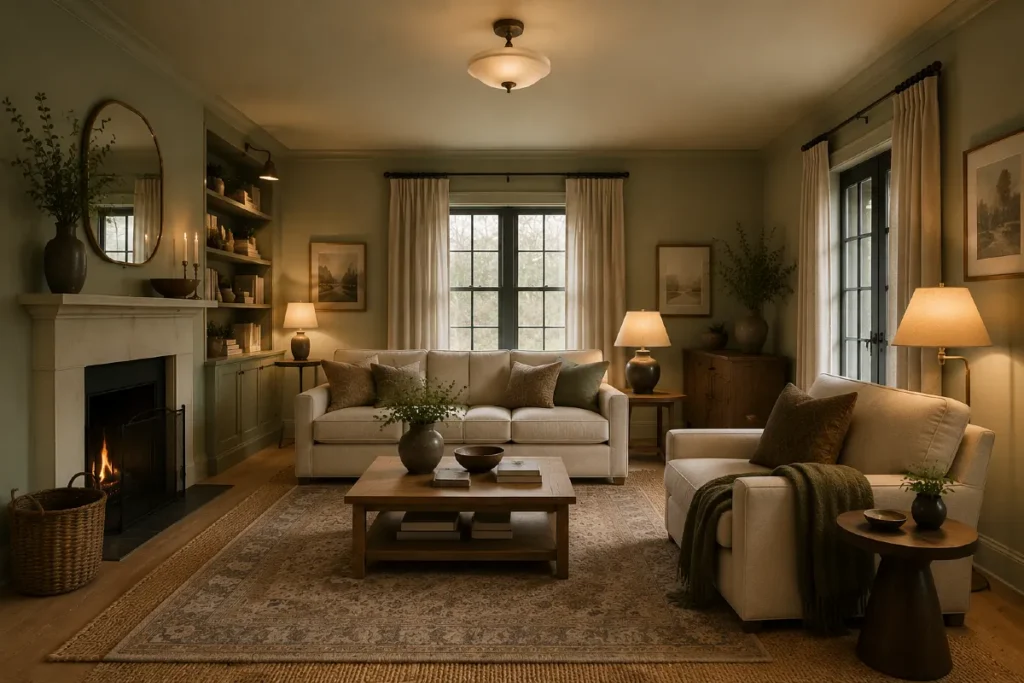
The ceiling may be the reason your room still feels unfinished.
Before you buy another pillow, lamp, or print, look up. Ask whether the ceiling blends with the room, fights the wall color, or feels forgotten.
The three big takeaways are simple. Treat the ceiling as the fifth wall. Use color continuity before spending more money. Match the ceiling choice to the room’s height, light, and mood.
Start with one photo from the doorway. Then choose whether your ceiling should blend, soften, contrast, or become a quiet focal point.
The simplest ceiling decor idea is to treat the ceiling as part of the room’s color story, because even a small overhead change can make the whole space feel more finished.