In 2026 the average interior designer charges between $100 and $500 an hour. Or they charge a flat fee upward of $5,000 just to tell you your sofa is too big for your living room.
Do you really want to pay that? You want a home that feels intentional and expertly curated. But spending your renovation budget on a consultation fee is not an option. You need practical help.
We are pulling back the curtain on the exact formulas professionals use right now. You will get the best free interior design advice available.
We cover everything from the curated calm aesthetic to spatial planning. You will also see how to use free AI software that renders professional mockups in seconds.
Consultation Fees Waived
Apply the 5 design secrets to save professional fees.
1. Color Drenching
Paint the ceiling, walls, and trim one unified dark color for a curated, immersive retreat.
2. Spatial Float
Pull furniture off the wall and hang curtains at the ceiling to create architectural height.
3. Layered Lighting
Never use “the big light.” Shift your ambient lamps to 3000K or lower for a cozy glow.
4. AI Sourcing
Reverse image search luxury showroom items to find manufacturer-direct duplicates.
5. The 80/20 Budget
Spend 80% on timeless anchor pieces (sofas) and 20% on trendy, swappable accents.
1. The Curated Calm Formula: Nailing 2026 Color Trends
Most people think painting everything bright white makes a room look larger and cleaner. A designer will tell you this cold minimalism actually makes your home feel like a sterile hospital.
We are seeing a massive shift in 2026 interior design trends. The new standard is warm minimalism. People want spaces that feel like a curated calm retreat.
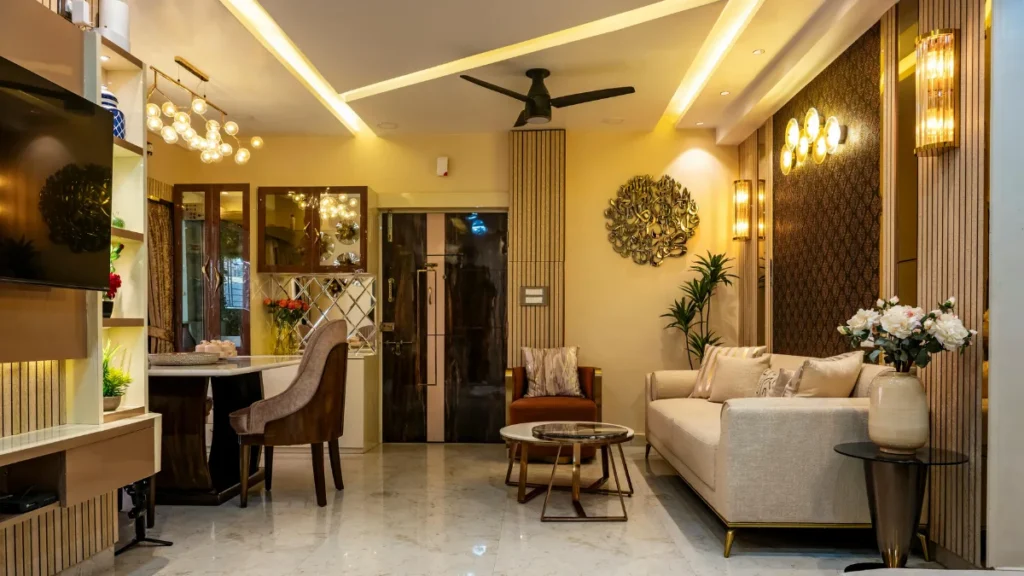
Cool grays and stark whites are completely out. The updated 2026 color palette features deep chocolate browns. You will also see espresso, rich terracotta, and muted jewels.
Professionals use a specific technique called Color Drenching to use these shades. You paint your walls, baseboards, window trim, and ceiling one cohesive dark hue. This creates a deeply immersive space. It feels like a warm hug.
Designers also follow a strict rule for mixing textures. You must pair sleek materials like stainless steel with tactile warmth. Think rich walnut wood, baked clay, and soft linen.
You should also replace glossy mass produced decor with what professionals call gentle clutter. Display your hand thrown pottery and stack your favorite books. Show off your visible ceramics on open shelves.
It is the current industry standard for lived in luxury. It makes a house feel like a home. Once your colors and textures are set, you must arrange your furniture correctly.
The $5,000 Rule: Paint your ceiling the exact same dark color as your walls to make the room feel endless and expensive.
2. 3 Mathematical Rules of Spatial Planning

Most people think pushing all their furniture flat against the walls creates more space. A designer will tell you this is the fastest way to make a room look cheap and empty.
You need to use The Float Rule. You should pull your sofa and chairs three to four inches away from the wall. This simple trick creates shadows and the illusion of a much larger room.
You must also follow room layout rules for visual balance. Professionals swear by the 60 30 10 proportion. Your dominant color or main furniture piece takes up 60 percent of the space.
Your secondary color takes 30 percent. Your accent color takes the final 10 percent.
You can achieve small space luxury by optimizing your vertical space. Draw the eye upward. Hang your drapery from the ceiling down to the floor.
Make sure you hang those curtains high and wide past the window frame. Add tall shelving units to emphasize height.
We are seeing a major 2026 architectural shift to multifunctional living areas in urban housing. You want to maximize your square footage. You can create hybrid spaces without physical dividers.
Hide a small desk behind a sofa. Use a rug to define a reading zone. This is a crucial step for any DIY home makeover. Once your layout is locked in, the next step is making sure it can actually be seen. That brings us to lighting.
The $5,000 Rule: Hang your curtains one inch from the ceiling to instantly add architectural height to any room.
3. Why Lighting is Everything: Layer Like a Professional
Most people think flipping on the main ceiling switch is enough to illuminate a room. A designer will tell you relying on the big light is a massive mistake.
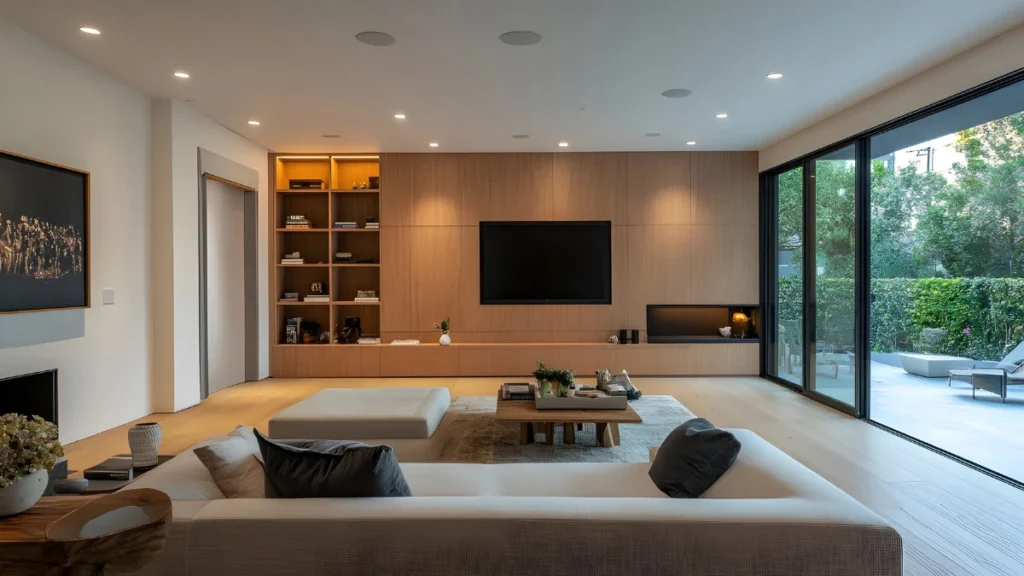
The big light casts harsh shadows and flattens your space completely. Interior design lighting requires strategy. Lighting a room is like dressing for winter. It is all about layers.
You must layer lighting to create a warm and inviting atmosphere. There are three essential layers you need to use:
- Ambient lighting provides general illumination for the room.
- Task lighting includes specific lamps for reading or cooking.
- Accent lighting highlights your art or interesting architecture.
The 2026 standard relies heavily on smart lighting. Professionals use circadian rhythm syncing smart bulbs. These are lights that match the natural color of the sun throughout the day.
They shift from cool daylight in the morning to warm amber in the evening. Your ambient lighting should sit around 2700K to 3000K for a cozy residential feel.
This free interior design advice will completely change how your home feels at night. Proper lighting makes cheap furniture look expensive. Once your lighting is perfect, you can start visualizing the final result with modern tools.
The $5,000 Rule: Never use bulbs cooler than 3000K in your living room if you want a cozy and relaxing atmosphere.
4. 3 Free AI Room Design Tools You Can Use Today

Most people think they need to hire a professional just to see what a renovation will look like. A designer will tell you that paying for these mockups is a waste of money today.
The AI interior design market valuation has reached 1.76 billion dollars in 2026. This huge growth means enterprise grade tech is now available to consumers for free.
You can bypass expensive designer fees completely. You just need to use generative AI home visualization platforms. There are specific AI room design tools for every job.
You can use Planner 5D to map out accurate and scaled floor plans. You can use VisualGPT or DecAI for instant photo to design mockups in 30 seconds. Remodel AI is the best overall choice for interior and exterior styling.
This free design software gives you incredible power. Here is a quick tutorial to get you started:
Instant Remodeling
The Warm Minimalism Workflow
Step 1: Capture
Take a photo of your living room during the day, ensuring you utilize soft, natural light for the best structural mapping.
Step 2: Connect
Securely upload it to Remodel AI. Our spatial engine will instantly analyze your room’s dimensions and existing furniture placement.
Step 3: Style
Select the Warm Minimalism filter from the design menu to apply a cozy palette of terracotta, sage, and sunlit earthy tones.
Step 4: Transform
Wait 15 seconds for the engine to process, and receive your professional rendering ready to inspire your next project.
Now you have a clear vision for your space. The final step is buying the items without paying a massive markup.
The $5,000 Rule: Always generate three different AI mockups before buying a single piece of furniture to avoid expensive mistakes.
5. 3 Sourcing Secrets to Shop Premium on a Low Budget

Most people think they have to buy everything brand new from an expensive showroom. A designer will tell you that buying showroom sets is a rookie mistake.
Designers typically charge a 20 to 35 percent markup on furniture purchases. You can save thousands instantly by sourcing items directly. You must learn these designer sourcing secrets.
First, use the 80 20 budget rule. You should spend 80 percent of your money on timeless anchor pieces.
These include sofas, beds, and solid dining tables. You then spend the remaining 20 percent on trendy accents that are easy to swap out later.
Next, skip the cheap fast furniture entirely. Designers prefer to source architectural salvage and vintage pieces. These items bring character and history to your DIY home makeover.
Finally, you can use technology to find affordable home decor. Find a picture of a premium showroom piece you love. Run that image through Google Lens to do a reverse image search.
You will easily find manufacturer direct duplicates for a fraction of the price. You get the exact same look without the luxury price tag.
The $5,000 Rule: Use reverse image search on every premium piece of furniture you like to find identical items for half the price.
Cost Comparison: Designer Fees vs. Free 2026 Alternatives
| Design Service | What Professionals Charge in 2026 | Your Free Alternative |
| Room Layout Planning | $100 to $500 per hour | Use Planner 5D for free digital floor plans |
| Custom Color Selection | $500 flat fee | Paint your ceiling and walls the same dark color |
| Professional Room Mockups | $2,000 or more per room | Upload a quick photo to Remodel AI |
| Furniture Shopping | 20 to 35 percent price markup | Use Google Lens to find the direct maker |
| Total Estimated Cost | $5,000 or more | $0 |
Conclusion
True luxury is never just about your budget. It is about knowing spatial mathematics and intentional material mixing. It requires layered lighting and leveraging modern AI tools.
You now have the exact formulas the professionals use to create stunning spaces. You do not need to spend thousands of dollars on consultation fees.
You can take action right now. Pick one room in your house that needs help. Snap a quick photo of that space. Run it through a free AI tool today to see the possibilities.